
EMI Calculator: Calculate Loan EMI Online (2026 Guide)
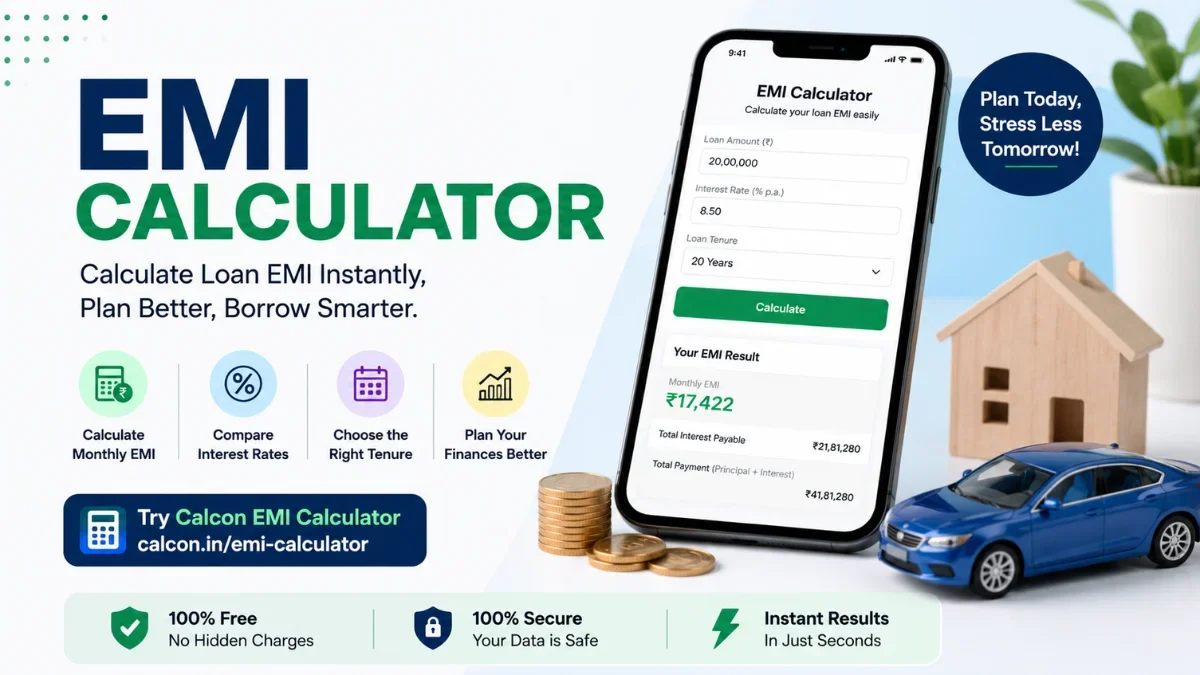
Before you sign any loan, one number decides everything: the EMI. Get it wrong and a home or car loan quietly strains your budget for years. An EMI calculator answers the real question — “What will I actually pay each month, and how much will this loan cost in total?” — in seconds.
This guide gives you the EMI formula, worked examples for home, car and personal loans, and the one table that matters most: how tenure quietly changes your total interest. Run your own numbers with the free Calcon EMI Calculator, which also shows a full month-by-month breakdown.
What Is EMI?
EMI stands for Equated Monthly Instalment — the fixed amount you pay each month to repay a loan over its tenure. Every EMI has two parts: a portion that repays the principal (the amount borrowed) and a portion that pays interest on the balance still owed.
Here is the part most people don't realise: the split changes over time. Early EMIs are mostly interest; later EMIs are mostly principal. This is called amortisation, and it is exactly why prepaying a loan early saves so much more than prepaying it late.
The EMI Formula (How the Calculator Works)
Every EMI calculator uses this formula:
EMI = P × r × (1 + r)ⁿ ÷ [ (1 + r)ⁿ − 1 ]
Where:
• P = principal (loan amount)
• r = monthly interest rate (annual rate ÷ 12 ÷ 100)
• n = number of monthly instalments (tenure in months)
You never need to compute this by hand, but it explains the two levers that control your EMI: the rate and the tenure. Push the tenure longer and the EMI falls — but because interest keeps accruing for more months, the total you repay climbs sharply. That trade-off is the heart of loan planning.
EMI Examples: Home, Car, Personal & Education Loans
Worked at typical illustrative rates (actual rates depend on your lender and credit profile):
Loan type | Amount | Rate | Tenure | Monthly EMI | Total interest |
|---|---|---|---|---|---|
Home loan | ₹30 lakh | 8.5% | 20 yr | ₹26,034 | ₹32.48 lakh |
Car loan | ₹8 lakh | 9% | 5 yr | ₹16,606 | ₹1.96 lakh |
Personal loan | ₹5 lakh | 12% | 3 yr | ₹16,607 | ₹0.98 lakh |
Education loan | ₹10 lakh | 10% | 7 yr | ₹16,601 | ₹3.94 lakh |
Notice the home loan: you borrow ₹30 lakh but repay over ₹62 lakh, because interest runs for 20 years. That is normal for long tenures — and it is exactly why the next table matters.
The Tenure Trade-Off (the Table Most Guides Skip)
Same ₹30 lakh home loan at 8.5% — only the tenure changes. Watch the EMI fall while total interest balloons:
Tenure | Monthly EMI | Total interest | Total repaid |
|---|---|---|---|
10 years | ₹37,196 | ₹14.64 lakh | ₹44.64 lakh |
15 years | ₹29,542 | ₹23.18 lakh | ₹53.18 lakh |
20 years | ₹26,034 | ₹32.48 lakh | ₹62.48 lakh |
25 years | ₹24,156 | ₹42.47 lakh | ₹72.47 lakh |
30 years | ₹23,071 | ₹53.06 lakh | ₹83.06 lakh |
The lesson: stretching from 15 to 30 years cuts the EMI by only about ₹6,500, but more than doubles the interest — from ₹23 lakh to ₹53 lakh. Choose the shortest tenure whose EMI you can comfortably afford, not the longest one a lender offers.
What Affects Your EMI
• Loan amount. Higher principal, higher EMI — borrow only what you genuinely need.
• Interest rate. Even a 0.5% difference matters over 20 years. Compare lenders and improve your credit score before applying.
• Tenure. Longer lowers the EMI but raises total interest; shorter does the reverse.
• Rate type. Fixed-rate EMIs stay constant; floating-rate EMIs move with the lender's benchmark, so they can rise or fall during the loan.
How Much EMI Can You Afford?
A widely used guideline: keep your total EMIs under 40–50% of your monthly take-home income. Lenders themselves assess this as your FOIR (Fixed Obligation to Income Ratio). If you earn ₹1 lakh a month, aim to keep all EMIs combined under ₹40,000–50,000 — and leave room for an emergency fund, because the EMI must be paid even in a bad month.
Prepayment: The Fastest Way to Save Interest
Because early EMIs are mostly interest, prepaying in the first half of a loan saves dramatically more than prepaying near the end. Even one extra EMI a year, or a lump sum from a bonus, can shave years and lakhs off a home loan. Floating-rate home loans usually carry no prepayment penalty for individuals, though fixed-rate and some personal loans may. Use the calculator's breakdown to see how a prepayment shortens your schedule.
How to Use the Calcon EMI Calculator
1. Open the calculator: calcon.in/emi-calculator.
2. Enter the loan amount.
3. Enter the annual interest rate.
4. Set the tenure in months or years.
5. Read your EMI, total interest, and total payment — plus the full amortisation schedule — then adjust to compare options.
Frequently Asked Questions
What is a good EMI amount?
A comfortable level is total EMIs under 40–50% of your monthly take-home pay, leaving room for savings and emergencies. Lenders also use this ratio (FOIR) to approve loans.
Is my EMI fixed every month?
On a fixed-rate loan, yes. On a floating-rate loan, the EMI (or the tenure) can change when the lender revises its benchmark rate.
Does a longer tenure save money?
It lowers the monthly EMI but increases total interest significantly, as the tenure table above shows. Shorter tenures cost less overall.
Can I repay my loan early?
Yes. Floating-rate home loans generally have no prepayment penalty for individuals; some fixed-rate and personal loans may charge a fee. Prepaying early saves the most interest.
Does the calculator include processing fees?
No. It shows EMI based on principal, rate, and tenure. Add any processing fee or insurance separately when budgeting the true cost.
The Bottom Line
An EMI is more than a monthly number — it is a multi-year commitment whose true cost lives in the total interest. Check the EMI, study the tenure trade-off, and borrow within a comfortable share of your income. When you are ready, plan it precisely with the free Calcon EMI Calculator.
Disclaimer: The EMI figures here are estimates based on illustrative interest rates and are for educational purposes only, not financial advice. Actual rates, fees, and terms vary by lender and credit profile. Confirm details with your bank before borrowing.
Related Tools
Get new tools & guides
Occasional updates, no spam.
Latest Posts

PPF vs SIP: Where Should You Put Your Money?

SCSS vs CSS: What's the Difference & How to Compile SCSS to CSS

PPF vs Mutual Fund SIP: Which is Better for Long-Term Wealth Creation?
How to Resize Photo & Signature for Online Exam Forms (Size + KB Guide)
How to Resize Image Dimensions Online (Width, Height & Aspect Ratio)